
Most conversations about metal recycling start and stop with the environment. But if you run a manufacturing plant, a demolition operation, or an industrial facility, environmental talking points aren’t what drive your quarterly decisions.
What drives those decisions? Hard numbers. Operational performance. Risk exposure. And competitive positioning that actually shows up in a bid.
Here’s what most businesses still haven’t figured out: a structured scrap metal recycling program delivers measurable advantages across your P&L, your facility operations, your supply chain, and your compliance posture. The environment is just one of them.
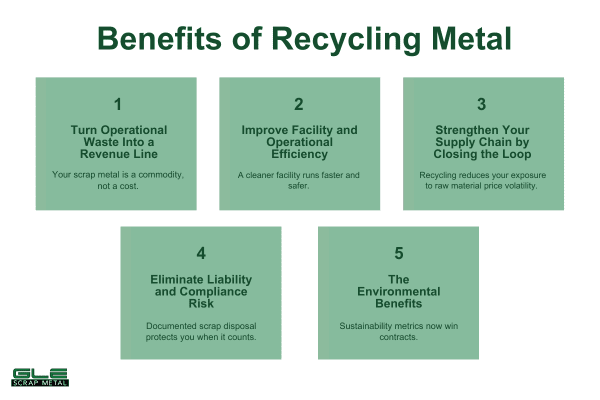
1. Turn Operational Waste Into a Revenue Line
Walk any active manufacturing floor, demolition site, or HVAC operation, and you’ll find it: copper wire runs, aluminum extrusions, brass fittings, and metal remnants quietly accumulating in corners, containers, and scrap bins.
Without a formal program, that material either creates a disposal problem or gets hauled away at a cost, and either outcome means your organization absorbs a loss on material that carries real market value.
Your Scrap Has More Value Than You Think
Here’s the thing: metals like copper, aluminum, and brass aren’t junk. They’re actively traded commodities, and high-volume generators in construction, HVAC, and manufacturing produce significant weight over time.
A structured scrap program, with scheduled pickups, designated containment, and materials sorted by metal type, repositions that accumulation from a cost center into a direct revenue offset. That offset reduces your materials and waste disposal costs every single month, and it compounds as your operation scales.
Stop Absorbing Disposal Costs
Most businesses don’t realize they’re paying twice, once to produce the scrap and again to dispose of it. A formal recycling program eliminates that second cost entirely and replaces it with a credit.
That’s not just recycling in a business context. That’s a procurement offset strategy disguised as a waste management program.
2. Improve Facility and Operational Efficiency
Scrap accumulation doesn’t just cost money; it costs space, throughput, and safety compliance overhead that compounds quietly over time.
Unsorted metal waste on production floors creates physical hazards, slows material handling, and generates congestion around staging areas and loading docks that nobody budgeted for.
A Cleaner Facility Is a Faster Facility
But here’s what most operators don’t anticipate: implementing scheduled pickups and on-site bin programs delivers immediate operational clarity. Production floors stay clear, material handling bottlenecks disappear, and your teams spend less time navigating around accumulated scrap and more time moving product.
That’s a direct throughput gain, and it doesn’t require a capital investment to achieve it.
Reduce Your Safety and Compliance Exposure
Unmanaged metal waste creates documented safety liabilities that surface during inspections, audits, and incident investigations. Proactively managing scrap removal through a structured program closes that exposure before it becomes a recorded incident or a compliance finding.
Compliance exposure from improperly managed metal waste drops significantly when you have a program in place, a paper trail for material removal, and scheduled pickups that keep your facility operating the way it was designed to.

3. Strengthen Your Supply Chain by Closing the Loop
Here’s an angle most operations teams overlook entirely: the scrap metal your facility generates today re-enters the supply chain tomorrow as recycled raw material.
That circular flow matters because it directly affects material pricing across the industry, and your supply chain exposure specifically.
Reduce Your Dependency on Volatile Raw Material Pricing
Businesses that actively participate in closed-loop material flows reduce their dependency on raw commodity pricing. When tariffs spike, import costs rise, or geopolitical pressures disrupt mining supply chains, companies with relationships to recycled material suppliers and supply chain flexibility absorb far less of the price shock.
The advantages of recycling go beyond feel-good sustainability metrics; they directly influence what you pay for raw materials next quarter.
Tariffs and Trade Pressure Are Making This More Urgent
The current tariff environment has made raw material price volatility a front-of-mind issue for procurement directors and operations managers across manufacturing and construction. Import costs on primary metals have created price exposure that pressures margins in ways that are increasingly difficult to absorb.
Reducing that exposure, even partially, through a closed-loop scrap strategy is a supply chain move, not just an environmental one. For procurement teams managing tight materials budgets, thinking about recycling as a supply chain strategy fundamentally changes the conversation.
4. Eliminate Liability and Compliance Risk
Not all metal disposal is equal, and the distinction matters far more than most businesses realize, until they’re sitting across from an auditor.
Certain metals and metal-containing components carry strict environmental disposal requirements that vary by material type, jurisdiction, and industry classification.
The Chain of Custody Problem Most Businesses Ignore
For hospitals, government contractors, and municipalities, the chain of custody on scrapped materials is a compliance issue, not a logistics preference. Businesses that don’t document scrap disposal can face serious exposure during audits, vendor evaluations, and contract renewals, and that exposure is entirely avoidable.
Working with a certified, established scrap metal recycler delivers proper documentation, a clear chain of custody, and a verified paper trail that holds up under scrutiny.
Turn Compliance Into a Competitive Qualifier
For organizations that respond to government and institutional RFPs, documented and compliant scrap disposal isn’t optional; it’s a baseline qualification requirement that your procurement team needs to be able to demonstrate on demand.
A structured recycling program with the right partner doesn’t just eliminate the liability. It actively strengthens your position when competing for contracts where vendor compliance documentation is part of the evaluation criteria.
5. The Environmental Benefit Now Has Direct Business Consequences
Yes, the environmental benefit is real. But the reason it now belongs in a business strategy conversation is that the business consequences of ignoring it have become equally real.
Mid-to-large businesses face growing pressure from customers, investors, and procurement teams to quantify and report on sustainability metrics.
Recycling Generates Reportable Data Points
Metal recycling participation produces measurable, reportable figures: volume of material diverted from disposal, energy savings versus virgin material production, and carbon equivalent reductions that directly support formal sustainability reporting requirements.
These aren’t soft talking points or buzzwords. They’re documented data points that belong in your reports, your corporate sustainability summary, and your vendor qualification submissions.
Use It to Win Business
For companies competing for institutional accounts, large construction contracts, or corporate supplier relationships, a documented recycling program can be a decisive differentiator in the bid process. Your competitors without a program simply cannot make the same claim, and increasingly, that gap matters to the decision-makers evaluating your submission.
Build a stronger reputation, support your sustainability reporting obligations, and turn a compliance requirement into a business development asset. That’s the full-circle value of what most companies still treat as a disposal afterthought.

Unlock The Competitive Advantages of Recycling With GLE Scrap Metal
The bottom line? A scrap metal recycling program built around your operation delivers advantages that show up across your P&L, your facility, your supply chain, and your compliance posture, not just in your sustainability report.
GLE Scrap Metal partners with manufacturers, contractors, HVAC operators, municipalities, and industrial businesses to build structured scrap programs that make operational and financial sense. We handle the logistics so you can capture the full value of every pound.
Contact GLE Scrap Metal to get started or request a quote to see the advantages of recycling for yourself.